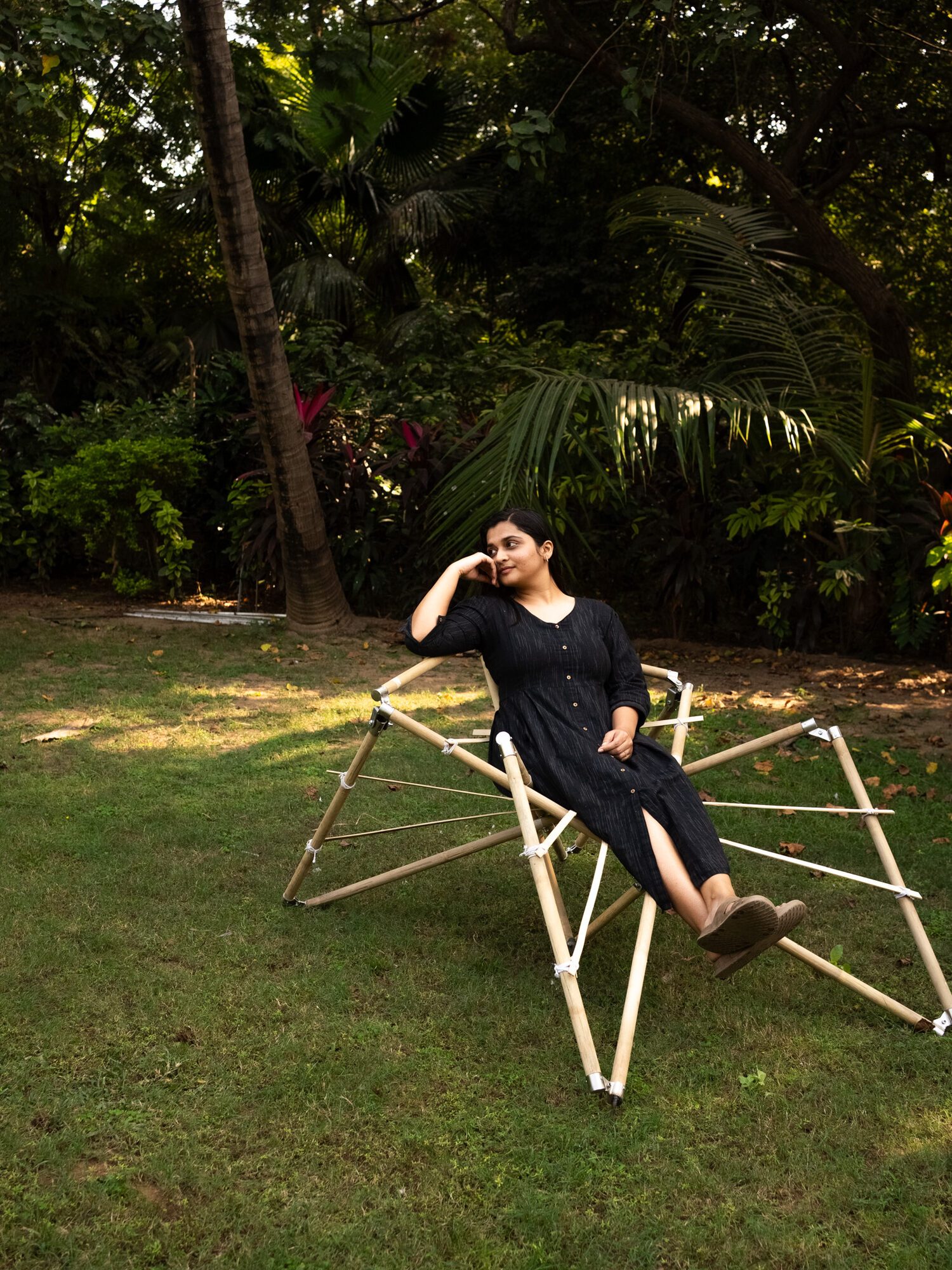
Hy-par chair
Category: Furniture
Most collapsible furniture treats folding as a mechanical chore, relying on flat, predictable folds that feel stiff and industrial. Hypar reimagines deployable design by making bamboo the absolute hero of the system. It is a kinetic garden lounge chair that transforms from a tight, compact bundle into an open, three-dimensional hyperbolic paraboloid surface. This complex, twisting movement is not achieved through high-tech machinery, but by unlocking the natural structural genius hidden inside the bamboo stalk. Using bamboo wasn't just an eco-friendly aesthetic choice for this project; it was a structural necessity. To achieve a coordinated, multi-axis rotation that smoothly moves from a linear bundle into a load-bearing seat, the material had to possess a highly specific, contradictory mix of properties: it needed to be incredibly strong under tension, yet light enough to move effortlessly. Bamboo is often called "natural steel," and for good reason. Its vascular bundles run continuously down the length of the stalk, giving it a tensile strength that rivals structural steel. As the Hypar chair opens, the intersecting bars undergo intense twisting, bending, and pull-forces. Ordinary timber dowels would snap under this multi-axis stress, and metals would permanently bend or require heavy, complex joints. Bamboo absorbs these forces effortlessly, distributing the tension across its long, continuous fibers and snapping right back into place. Bamboo offers an unparalleled strength-to-weight ratio. This ultra-lightweight profile is what makes the chair's three-dimensional transformation feel magical and effortless to execute by hand. It eliminates the dead weight associated with solid wood or iron components, allowing the entire structural grid to glide into place with minimal friction. By using bamboo, Hypar completely rejects conventional, rigid hinges and flat linkages. The structure relies on a quiet, shared harmony of tension and balance where the material itself acts as the mechanism. The straight, natural lines of the stalks are organized into a matrix that gracefully negotiates weight, using its inherent elastic give to cushion the user without the need for synthetic components. Designed for the outdoors, Hypar’s open-grid configuration allows light, wind, and the surrounding landscape to flow freely through it, turning a space-saving object into a quiet frame for experiencing nature. Ultimately, the project proves that advanced, mathematical design doesn't require synthetic innovation, it simply requires us to listen to the raw, lightweight, and resilient strength that nature has already perfected.
 Copy URL
 Login to Like 1